
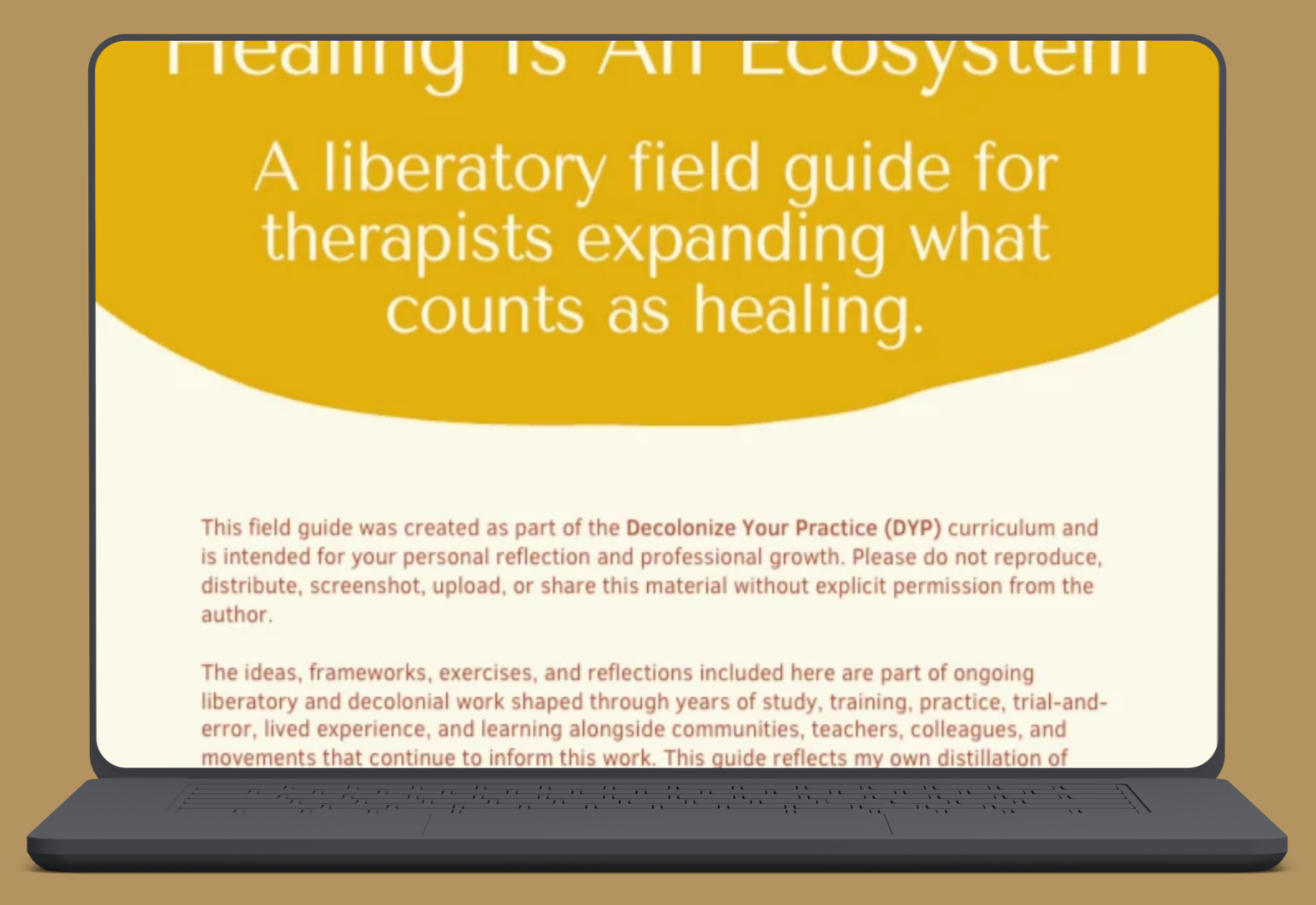
Healing Is An Ecosystem
Stop treating therapy as the whole ecosystem. Start noticing the conditions, relationships, communities, and possibilities that make healing possible.
A self-paced field guide for therapists, clinicians, healers, and space-holders who want to expand what counts as healing—and what they make room for beyond the therapy room.
Therapy can be meaningful, life-saving.
It can also be one small part of a much larger ecosystem.
Healing Is An Ecosystem (HIAE) is a self-paced field guide for clinicians and healers who are ready to look beyond the familiar referral list and ask a different set of questions:
What conditions help people heal?
What exists outside our profession that supports wellbeing?
And what happens when we let go of the expectation that healing is the sole responsibility of the therapist?
This isn't a directory of resources or a list of things your clients "should" be doing.
It's a framework for expanding your clinical imagination.

You don't have to become everything your clients need.
You may be tired of feeling like the person responsible for holding the entire weight of someone's healing.
You've helped someone process.
You've taught coping skills.
You've worked on boundaries, communication, emotional regulation, self-advocacy, and behavior change.
You've referred to another therapist.
Maybe a psychiatrist.
Maybe a doctor.
And yet...
They still don't feel like they belong anywhere.
They're still exhausted.
Their symptoms aren't changing.
They're still living somewhere unsafe.
They're still isolated.
They're still grieving.
They're still disconnected from their culture, body, community, land, purpose, or sense of possibility.
And sometimes the answer isn't more therapy.
Sometimes the conditions around the person need to change.
That's not a failure of therapy.
It's a reminder that therapy was never the whole ecosystem.
What if healing requires more than a good therapist?
Healing Is An Ecosystem invites you to look beyond the therapy room without diminishing the value of what happens inside it.
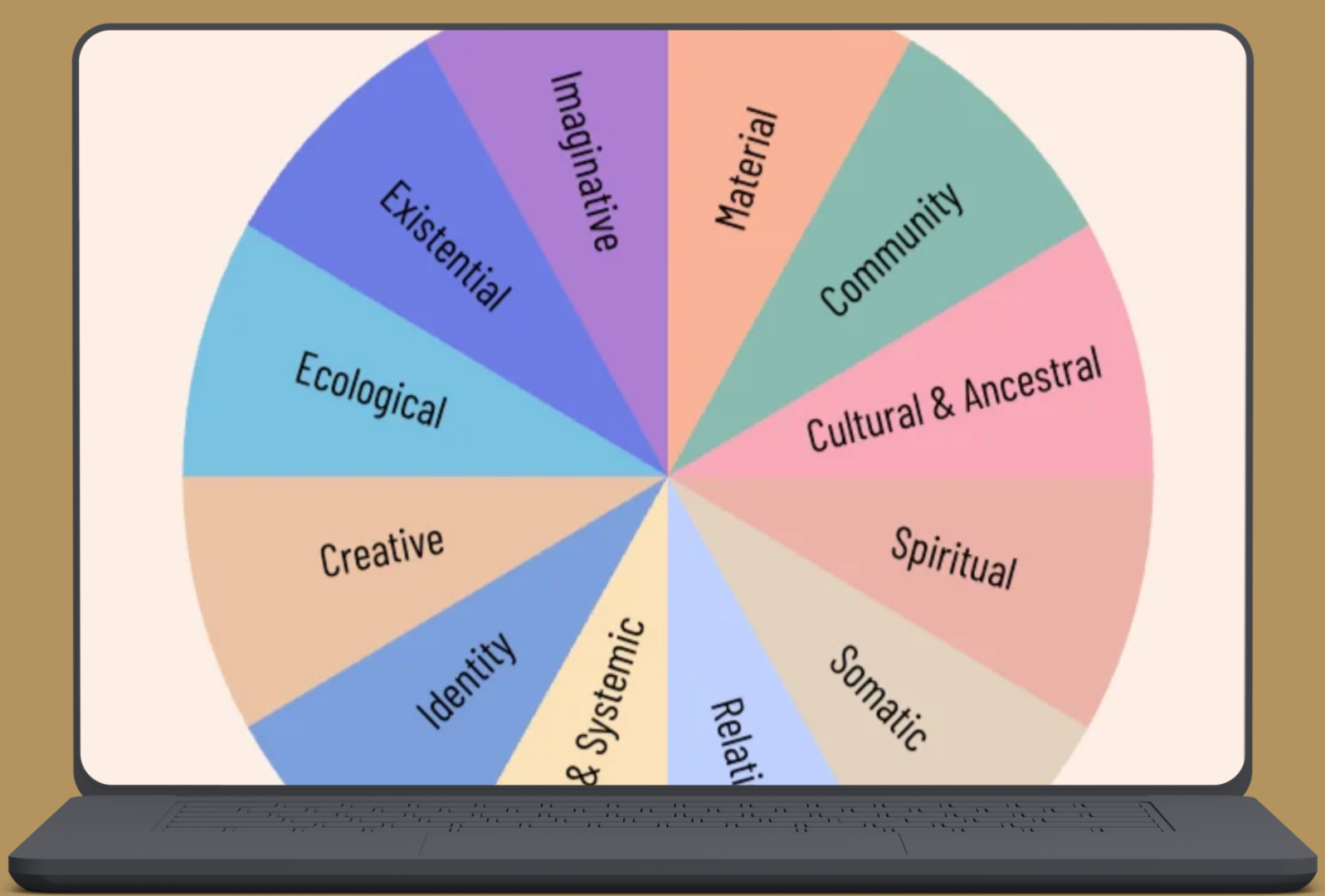
You'll explore 12 conditions that can shape a person's capacity for healing and wellbeing:
Material:
Because housing, food, money, healthcare, safety, and access matter.
Community:
Because people need people, and belonging is not a luxury.
Cultural & Ancestral:
Because culture, language, lineage, tradition, and memory can be part of how we make meaning and experience belonging.
Spiritual:
Because not everything meaningful fits neatly inside a psychological framework.
Somatic:
Because bodies have needs that cognition cannot think their way out of.
Relational:
Because healing doesn't happen in isolation.
Political & Systemic:
Because what gets called an individual problem can have systemic roots.
Identity:
Because knowing who we are—and having room to be that person—matters.
Creative:
Because making, imagining, playing, and creating can be ways of relating to ourselves and the world.
Ecological:
Because we are not separate from the living world around us.
Existential:
Because some questions aren't problems to solve. They're realities we have to learn how to live.
Imaginative:
Because survival can narrow what we believe is possible—and liberation asks us to imagine beyond it.
This isn't a referral directory.
And that's intentional.
You won't find a list of phone numbers, websites, or "top 10 resources" to hand your clients.
Those resources matter.
But a list can also become another shortcut.
It can keep us from asking:
What does this particular person need?
Who already exists in their world?
What is available in their community?
What have we not thought to look for?
What could we imagine if we weren't limited to the referral pathways our training taught us?
This guide gives you a way to think beyond the list.
Each condition includes reflection, a question to deepen your inquiry, and space to consider who, where, or what might help cultivate those conditions.
The goal isn't to complete the ecosystem.
It's to learn how to see it.
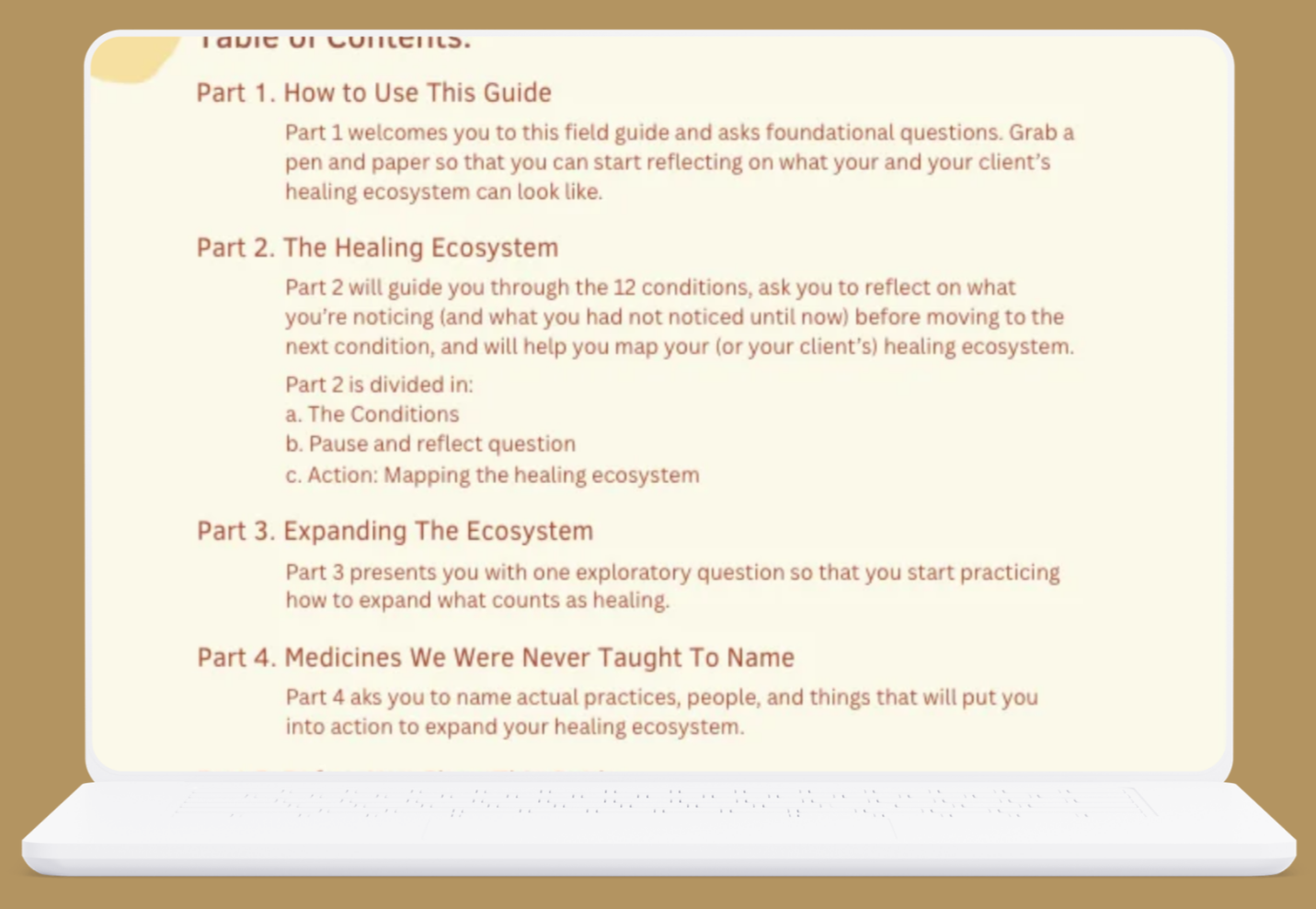
Inside the field guide
You'll move through three layers:
01 — The Conditions
A framework for understanding the material, relational, cultural, political, ecological, spiritual, somatic, creative, existential, and imaginative conditions that shape wellbeing.
02 — The Questions
Each condition includes a question designed to interrupt familiar clinical assumptions and invite deeper inquiry—with your clients, in consultation, or in your own life.
03 — Expanding the Ecosystem
You'll have space to think beyond therapists and other mental health professionals and identify the people, places, communities, practices, and systems that could become part of a larger ecosystem of support.
And then we go one step further:
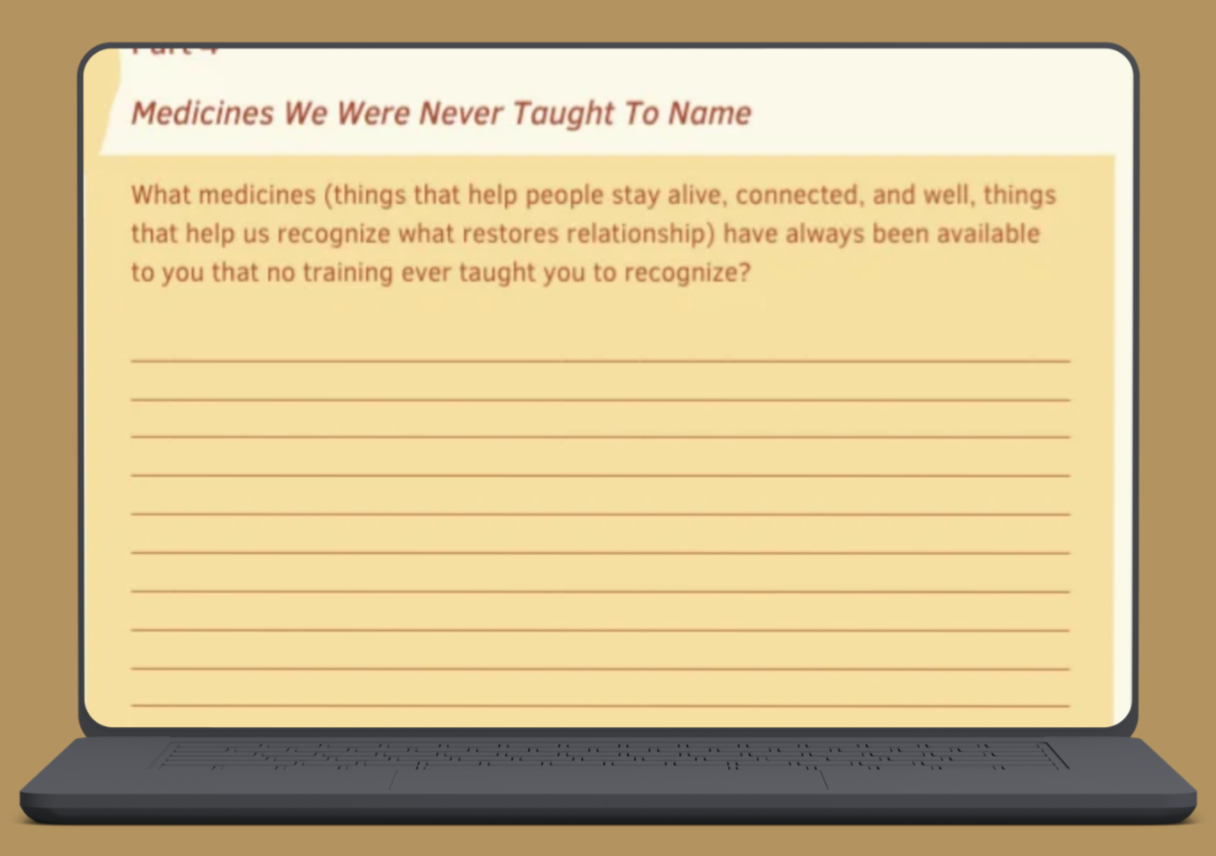
04 — Medicines We Were Never Taught to Name
A closing reflection on the forms of care, connection, pleasure, creativity, grief, resistance, belonging, and possibility that Western psychology has often left unnamed.
Because not everything that helps us live can be measured, diagnosed, or billed.
This field guide is for you if you:
sometimes wonder whether you're asking therapy to carry too much.
want to expand your understanding of what contributes to wellbeing.
find yourself reaching for the same familiar referrals.
want to think beyond psychiatrists, physicians, and other therapists.
notice that some clients' distress makes little sense without looking at their conditions.
want more ways to talk about healing without making everything another clinical intervention.
are interested in practicing in ways that are more relational, contextual, and liberatory.
want something you can actually use, rather than another training, certification, or credential to add to the ever-growing list of things you're supposed to keep accumulating.
are willing to question some of the assumptions your professional training gave you about what healing is supposed to look like.
You don't need to be new to this work.
You also don't need to have all the language figured out.
This guide is for clinicians who are willing to stay curious.
This field guide is not for you if you:
are looking for a directory of ready-made referrals.
want a checklist of everything your clients "should" have.
are looking for another set of interventions to add to your treatment plan.
want a formula for determining exactly what every client needs.
want to replace therapy altogether with a new set of answers, practices, or prescriptions.
want a quick way to fix problems that are shaped by conditions outside the therapy room.
are not interested in questioning the professional assumptions that shape how you understand healing.
This isn't about doing more.
It's about seeing more.
What you'll get
You'll get:
A framework for thinking about healing as an ecosystem rather than something therapy has to provide on its own
12 conditions to explore, from material and community conditions to cultural, ecological, creative, political, existential, and imaginative conditions
A powerful reflection question for each condition to help you notice what may be missing, overlooked, or outside your usual clinical frame
A mapping exercise for each condition to help you think about the people, places, communities, and forms of support that could become part of someone's healing ecosystem
A closing section on the medicines we were never taught to name—the forms of care, connection, pleasure, resistance, creativity, and belonging that Western psychology often leaves outside the frame
Prompts to bring into your own practice, consultation, or conversations with clients
You can move through it in one sitting or return to one condition at a time.
There is no completion deadline.
There is no gold star for finishing all 60+ pages.
Because, honestly, that would rather defeat the point.
How long will it take?
There isn't one right way to use this guide.
You could read through it in an afternoon.
You could spend 10–15 minutes with one condition and return later.
You could use one section as a consultation prompt.
You could work through it yourself before bringing a question into a session.
Think of it as something you return to—not something you finish.
Pricing
Introductory price: $35
Regular price: $39
Need a lower-cost option? A limited number of copies are available for $29 on the honor system. No questions asked—just trust that you're choosing the price that reflects your capacity.
About the author
About Silvana
I'm a psychotherapist in private practice, clinical supervisor, educator, consultant, and grief tender interested in what happens when we question the assumptions underneath mental health practice.
I work with therapists, healers, and space-holders who are interested in unlearning, expanding their understanding of healing, and practicing in ways that are more relational, contextual, and liberatory.
I like asking questions that make us rethink what we thought we already knew. I'm a collector of half-read books.
A few questions you might have (FAQ)
Is this a workbook or a training?
It's a self-paced field guide. There are concepts to read, questions to consider, and exercises to complete, but there are no videos, live sessions, or required assignments.
Do I need to be a therapist to purchase this field guide?
No. The guide is written primarily with therapists, clinicians, healers, and other practitioners in mind, but you don't need a particular degree or license to engage with it.
Is this a directory of referrals?
No. That's intentional. This guide helps you expand your thinking about where healing can happen rather than giving you a static list of providers and organizations.
Can I use this with clients?
Yes. You can use the reflection questions and framework as prompts for conversations with clients. It isn't a clinical protocol or treatment manual, and you'll want to use your own professional judgment about what is appropriate for each person.
Can I share this with colleagues?
Please don't share your copy with others.
I've poured lived experience, professional knowledge, intellectual labor, and creative labor into creating this guide, and I ask that you honor that work by purchasing your own copy.
You can absolutely share the link to this page with colleagues who you think would find it useful.
I trust you to honor this boundary.
Is this about replacing therapy?
No. Therapy is valuable, and this is no replacement.
This guide asks what becomes possible when we stop treating therapy as the only—or primary—place where healing happens.
Is this another decolonizing-your-practice checklist?
No. In fact, it's deliberately not a checklist.
You aren't being asked to complete every condition or become knowledgeable about every possible form of healing.
You're being invited to notice what you may have been trained not to notice.
How long do I have access?
It's yours to download and return to whenever you need it.
Can I get a refund?
All sales are final.
A note about using this guide
This guide is an invitation to expand clinical imagination—not a prescription for what every person needs.
The conditions described here will not be relevant to every person in the same way, and they should never become another checklist we impose on ourselves or our clients.
Use your judgment, stay curious, ask rather than assume.
And remember that your client's own knowledge—their lived experience, intuition, cultural knowledge, and ways of knowing—is part of the ecosystem, too.
The goal isn't to know what someone needs before they tell you.
The goal is to become better at asking—and better at listening to what comes back.
What this guide might change
You might leave with...
Less:
pressure to be your client's entire ecosystem.
reflex to reach for another clinical intervention.
assumptions that distress is always an individual problem.
same familiar referral pathways.
More:
questions that widen the frame.
language for talking about conditions, not just symptoms.
ideas for expanding your referral imagination.
permission to look beyond your profession.
spacious definition of what healing can be.
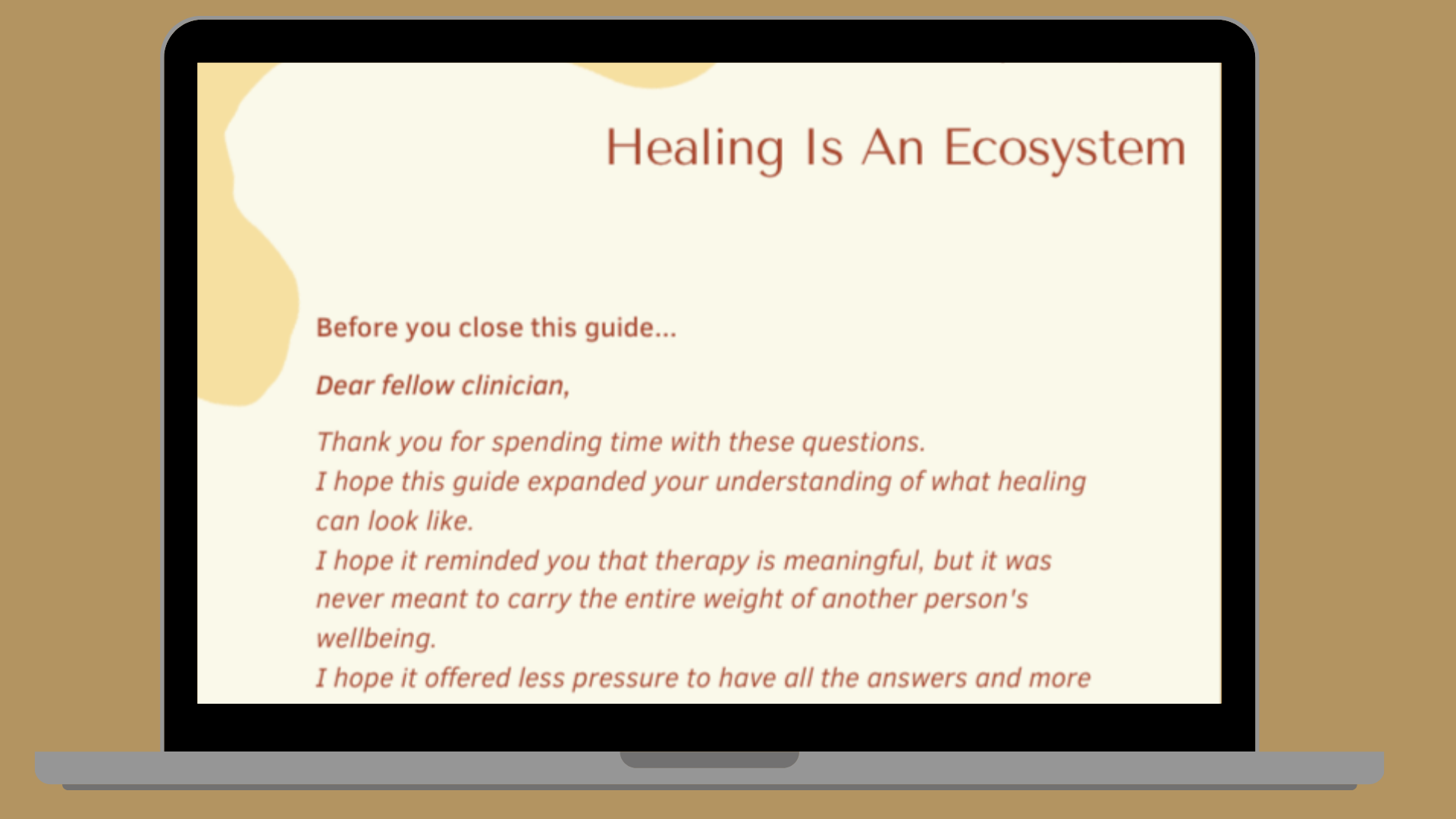
Ready to widen the frame?
Get Healing Is An Ecosystem and start looking beyond the therapy room.
$35 —introductory price
$39 —regular price
No CEUs. No certification. No perfect way to use it. A field guide for expanding what you know, what you notice, what you ask, and what you make room for.